The Arrival
Rizal arrived in Dapitan aboard a steamer, under the custody of Captain Ricardo Carnicero, the Spanish commandant assigned to oversee his exile. He was thirty years old. He had just founded La Liga Filipina — a civic organization he had spent months planning — and had been arrested four days after its first meeting. The speed of the arrest was itself a measure of how closely the colonial authorities had been watching him.
Dapitan was chosen for its remoteness. It was a small, predominantly Catholic town of perhaps a few thousand people on the northwestern coast of Mindanao, far from Manila, far from the ilustrado networks, far from the printing presses and political conversations that had made Rizal dangerous. The nearest significant city was Zamboanga, hours away by boat. The intention was isolation.
What the colonial authorities had not accounted for was what Rizal would do with isolation.
Captain Carnicero and the Lottery
The first surprise of the Dapitan years was the relationship that developed between Rizal and his jailer. Captain Ricardo Carnicero was not what Rizal had expected. He was a career military officer of reasonable intelligence and evident decency who treated his charge with a respect that went considerably beyond what the colonial government required of him. He allowed Rizal relative freedom of movement within the area, permitted him to receive visitors and correspondence, and engaged with him as something approaching an intellectual equal.
The two men, along with a Spanish resident named Francisco Equilor, shared a lottery ticket — a casual arrangement among neighbors that became considerably less casual when their ticket won the second prize of 20,000 pesos. Divided three ways, Rizal’s share came to approximately 6,200 pesos — a substantial sum that transformed his practical circumstances in Dapitan entirely. He had arrived as a prisoner of limited means. He now had the resources to build.
He used the money to purchase a tract of land in the coastal village of Talisay, about a kilometer from the center of Dapitan. On this land he would spend the next four years constructing the most fully realized version of the life he had always wanted to live.
Talisay: What He Built
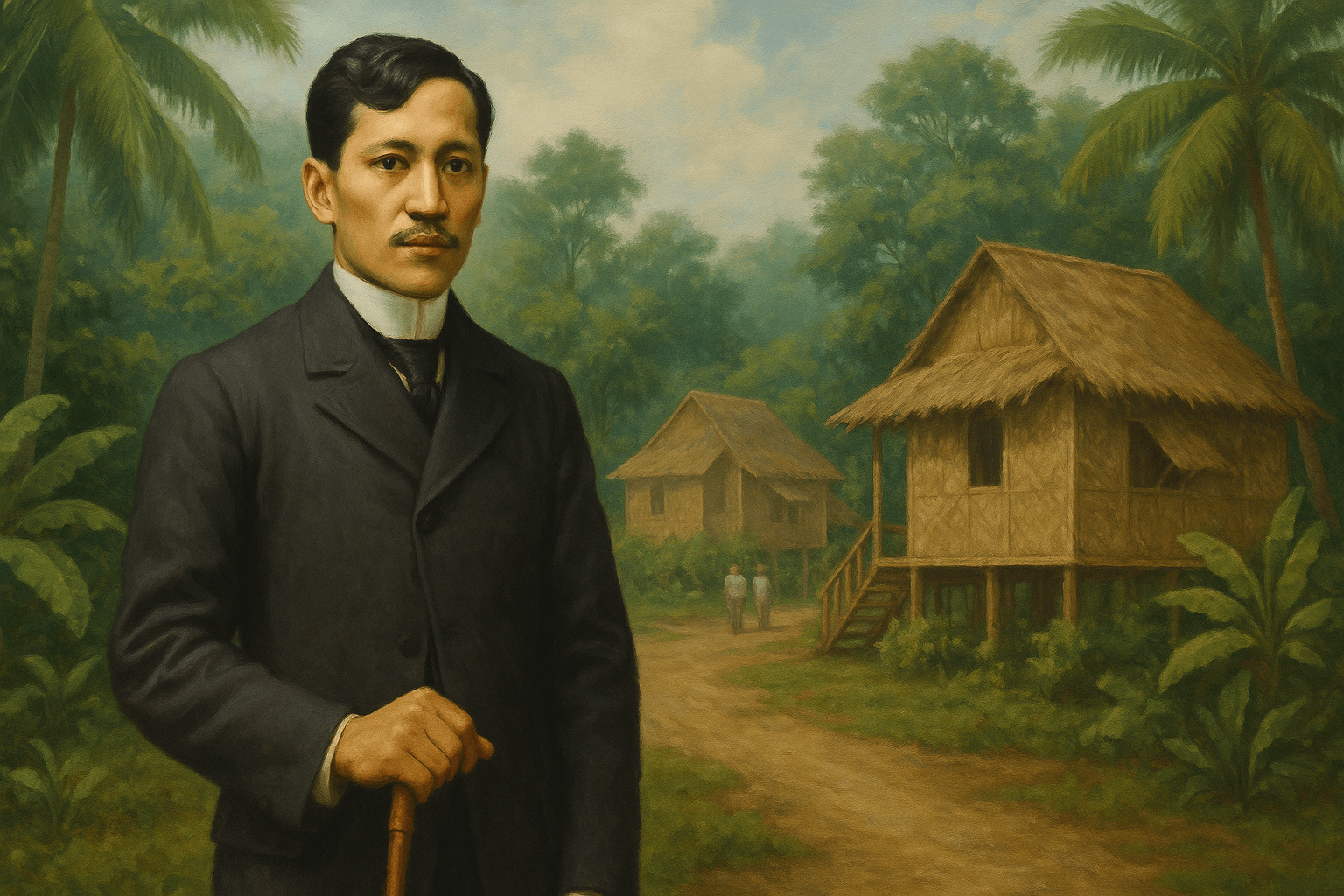
The estate at Talisay was Rizal’s physical project for the duration of his exile. He designed it himself — several wooden and bamboo structures arranged around a cleared space, surrounded by gardens and agricultural plots and the coastline where he swam and fished and collected specimens in the mornings.
He planted fruit trees: coconuts, mangoes, cacao, coffee. He raised animals. He cultivated a vegetable garden that supplied the household and his patients and students. He introduced improved farming techniques to the surrounding community, demonstrating rather than lecturing — growing things himself, letting the results speak.
His most significant engineering achievement was a water system. Dapitan had no reliable supply of clean water, a gap that contributed directly to the disease burden of the community. Rizal designed and supervised the construction of an aqueduct that brought water from a spring in the hills down to the town — a project that required surveying the terrain, calculating gradients, sourcing materials, and organizing the labor of people who had not built anything like it before. The system worked. It improved the health of the town measurably, reducing the incidence of waterborne disease in the surrounding area.
He also mapped the region with the thoroughness of a man who understood that accurate geographical knowledge was itself a form of power — knowledge the colonial administration had often deliberately withheld from Filipino communities.
The School
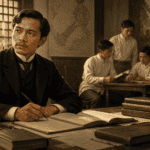
Rizal opened a school for boys in Dapitan within the first years of his exile, and it became one of the more quietly radical things he did there. He taught languages — Spanish, English, and some instruction in the local Visayan dialect — alongside mathematics, geography, history, and natural sciences. He also taught drawing, farming, and basic carpentry, on the principle that education useful to its recipients had to include practical skills alongside academic ones.
The school operated without the rigid structure of colonial education and without the censorship that governed what Filipino students in Manila were permitted to learn. Rizal taught what he thought was true and useful. He assigned outdoor exercises, took students on collecting trips along the shoreline, and encouraged the kind of observation and questioning that the colonial school system was specifically designed to suppress.
Some of his students became among the most capable men of their generation in the region. The school was small — a few dozen boys at most — but its influence on the community was disproportionate to its size.
Medicine
Rizal had trained as an ophthalmologist in Paris and Heidelberg with the specific intention of returning to the Philippines and treating the eye conditions that colonial-era medicine was not adequately addressing. In Dapitan he finally had the opportunity to do this work at scale.
Patients came from the surrounding region and from much further away — traveling for days by boat, in some cases, because word had spread that there was a skilled surgeon in Dapitan who would treat people regardless of their ability to pay. He performed cataract surgeries, treated trachoma and other infections, and managed chronic conditions with the limited pharmaceutical supplies available to him. He operated on his own mother’s eyes when she came to visit — the surgery he had been planning since he first realized, during his student years in Madrid, that her sight was failing.
He kept records. He corresponded with European medical colleagues about cases that interested him scientifically. He treated patients from the indigenous communities of the surrounding area as well as from the Spanish and mestizo populations of the town itself, without the racial distinctions that colonial medicine typically enforced.
His clinic was not a formal institution — it was a room in his house and whatever outdoor space the examination required. But it functioned, and it served people who would otherwise have had no access to the standard of care he provided.
The Naturalist
The Dapitan years were also, in ways that are easy to overlook against the more dramatic biographical narrative, among Rizal’s most scientifically productive. The forests and coastline of the Zamboanga peninsula were rich with species that European natural history had not yet catalogued, and Rizal — who had been interested in natural history since childhood and had maintained that interest through his European years — set about documenting them with the systematic energy of a man who understood that this work had both scientific and political dimensions.
He collected reptiles, insects, birds, fish, crustaceans, and shells. He preserved specimens in alcohol — which was difficult to source in Dapitan and had to be obtained through his contacts in Manila — and shipped them to the great natural history museums of Europe through a network of correspondents that included Dr. Adolph Meyer of the Dresden Museum and various contacts in Berlin. He traded specimens for books and scientific instruments, maintaining the same barter system he had used during his London years.
He wrote to Blumentritt that he was convinced the region still held species unknown to science, and he was right. Several of the creatures he collected and sent to Europe were identified by the scientists who received them as previously undescribed species, and named after him in recognition — including the flying lizard Draco rizali, the harlequin tree frog Rhacophorus rizali, and several beetle species. His name entered the permanent scientific record of the Philippines while he was in political exile, through the simple act of paying close attention to what lived in the forests around him.
He wrote to Blumentritt: My country can offer him treasures yet undiscovered. He meant it as an invitation. He was also describing himself.
The Letter About the Gun
One detail from the Dapitan correspondence captures the particular texture of those years better than any summary can. In a letter to Dr. Meyer in Dresden, Rizal explained that he had been unable to collect certain bird specimens because, as a deportee, he was not permitted to carry a firearm. He had wanted to shoot birds — not for pleasure, not for food, but for science, to prepare skins and skeletons for the Dresden collections. The colonial authorities had denied him this permission.
The image is striking: a man under political sentence, in exile for the crime of writing novels, writing apologetic letters to a German museum director to explain why his bird collection was incomplete because he was not allowed to own a shotgun. He added, typically: Nevertheless, I shall do all that I can.
He did.
Josephine
In early 1895, three years into his exile, George Taufer arrived in Dapitan with his adopted daughter Josephine Bracken, seeking treatment for an eye condition. What happened next has been covered in the article on Josephine Bracken. The short version is that Rizal fell in love with her, she stayed in Dapitan after Taufer left, they lived together as husband and wife, lost a child to premature birth, and she was with him when he finally left Dapitan in 1896.
Her presence during the last year and a half of his exile gave his daily life a domestic warmth it had not previously had. He introduced her to his students. She helped teach English in the school. She was woven into the fabric of the Talisay estate in ways that made the departure from Dapitan, when it came, a departure from a home rather than simply a release from imprisonment.
The Departure
On July 31, 1896, Rizal left Dapitan. He had secured permission from the colonial government to travel to Cuba as a volunteer military doctor — the island was dealing with a yellow fever outbreak that had overwhelmed the Spanish military’s medical capacity, and Rizal had offered his services. The permission was granted, partly because getting him out of the Philippines during a period of growing unrest suited the colonial authorities’ interests.
The townspeople of Dapitan came to see him off. The accounts of the departure describe something that looked less like the release of a political prisoner and more like the farewell of a community to a man who had become genuinely part of it. Students, patients, neighbors — people whose eyes he had operated on, whose children he had taught, whose water supply he had designed.
None of them knew, and he probably did not know either, that the journey would end at Fort Santiago rather than Havana.
What Four Years in Exile Actually Produced
The colonial government sent Rizal to Dapitan to neutralize him. It is worth being specific about what neutralization actually produced.
In four years, Rizal built a functioning water system for a town that had not had one. He opened a school that educated dozens of boys in subjects the colonial curriculum deliberately withheld. He performed eye surgery on patients who traveled for days to reach him. He catalogued species unknown to European science and placed them in the permanent scientific record. He won the lottery, used the money productively, and turned a piece of coastal land into a model of the kind of community development he had been arguing for in his essays for a decade.
He also maintained his correspondence network, kept writing, kept thinking, and kept being exactly what the colonial government had sent him to Dapitan to prevent him from being: a person of substantial practical usefulness to the people around him, operating on the basis of ideas about education and service and human dignity that the colonial system was built to suppress.
The Spanish colonial government spent four years trying to silence José Rizal. Dapitan is what silence looked like.
Read next: The Species Named After Rizal — the flying lizard, the tree frog, and the beetles that carry his name permanently in the scientific record of the Philippines.