The Departure
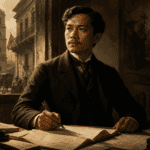
Rizal left Manila covertly because he had to. His brother Paciano — who had been associated with the martyred priest Father Burgos and whose surname had therefore become dangerous — had decided that José must study in Europe under a different name, away from the surveillance of the colonial authorities who had already begun to take an interest in the Mercado family. Their parents were not told until the ship had sailed. The secrecy was not melodrama. It was a reasonable precaution in a colony where the wrong family connection could end an education before it began.
He boarded the Salvadora on May 3, 1882, traveled to Singapore, then Colombo, then Suez, then through the Mediterranean. He kept a travel diary. He observed everything — the other passengers, the coastlines, the food, the behavior of the Spanish officers aboard — with the same precise, slightly ironical attention that would later characterize his novels. He arrived in Barcelona in late June.
He was not yet the man who would write Noli Me Tangere. He was a young provincial from Laguna with excellent grades, several languages, and no clear sense of what Europe was actually going to be.
Barcelona: First Contact
Barcelona in 1882 was a city in the middle of its own complicated argument about identity and autonomy — Catalan nationalism was stirring, the industrial working class was organizing, and the cafés were full of people who disagreed strenuously about everything. For a young man from a colonized country arriving in the metropolitan center of the empire that colonized it, the contrast was immediate and productive.
He wrote an essay almost immediately — Amor Patrio, Love of Country — which was published in a Manila newspaper under a pen name. It was his first published prose work, and it is striking for its directness: a young Filipino in Barcelona writing about what it means to love a homeland that has been taken from you. The Propaganda Movement that would later organize Filipino reformists in Europe did not yet exist. Rizal was working ahead of it by instinct.
He stayed in Barcelona only briefly before moving to Madrid to begin his formal university studies. But the weeks in Barcelona established something important: that Europe was not going to simply absorb him. He was going to argue back.
Madrid: The University Years
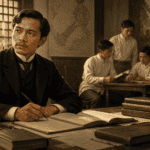
Rizal enrolled at the Universidad Central de Madrid in 1882, studying medicine. He also enrolled in the Faculty of Philosophy and Letters — simultaneously, while learning the city, learning to fence, attending the theatre, visiting the Prado, and beginning the social correspondence that would eventually connect him to almost every significant Filipino intellectual of his generation.
The academic record was extraordinary. He completed his licentiate in medicine and his licentiate in philosophy and letters, both with distinction. He studied ophthalmology with particular intensity — the decision to specialize in eye surgery was not arbitrary. His mother Teodora had been losing her sight, and he intended to return to the Philippines and treat her. The practical and the filial were inseparable in almost everything he did.
Madrid was also where he began to understand the Propaganda Movement — or rather, to become one of its central figures. Filipinos in Spain were not passive students. They organized, petitioned, published, argued, and debated with an intensity that the colonial administration back in Manila would have found alarming if they had known the full extent of it. Rizal was at the center of this world: writing for the reformist press, attending meetings of Filipino students and intellectuals, developing the political analysis that would eventually animate the novels.
He also fenced, sculpted, painted, and wrote poetry — not as hobbies but as genuine pursuits, pursued alongside medicine and philosophy and political journalism with an energy that exhausted the people around him. He wrote to Blumentritt in later years that he had wasted time in Madrid. He had not. He had been building.
Paris: The Eye Clinic and the Novel
In 1885, having completed his degrees in Madrid, Rizal moved to Paris to train under Dr. Louis de Wecker, one of the leading ophthalmologists in Europe. He worked in de Wecker’s clinic, assisting in surgeries and developing the technical precision that would later make him one of the more capable eye surgeons operating in the Philippines. He operated on his mother’s eyes after his return home in 1887. The surgery was successful.
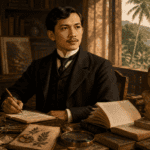
Paris was where the Noli began to take its final shape. Rizal had been carrying the idea for the novel since at least 1884, when he had proposed to a group of Filipino friends in Madrid that they collaborate on a book that would do for the Philippines what Uncle Tom’s Cabin had done for American slavery — a novel that would make the colonial system visible, human, and therefore impossible to look away from. The friends agreed in principle and contributed nothing. Rizal began writing alone.
In Paris he was also surrounded by the visual culture of one of the world’s great art cities. He visited museums, studied the collections, refined his sense of composition and detail. The Paris chapters of the Noli — the scenes set in Europe, the rendering of Ibarra’s cultivated consciousness — have a particular visual density that reflects the environment in which they were written.
He moved on to Germany before the manuscript was finished, but Paris had given him the middle of the book and a clearer sense of how to end it.
Heidelberg and Berlin: Where the Novel Was Completed
Rizal arrived in Heidelberg in February 1886 to continue his ophthalmology training at the university eye clinic there. He found the German intellectual culture immediately congenial — methodical, serious, empirically rigorous in a way that Spanish academic culture was not. He learned German quickly. He read widely in the university libraries. He walked along the Neckar River in the evenings and wrote, among other things, a poem about the flowers of Heidelberg — A las Flores del Heidelberg — that manages to be simultaneously about botany and about exile and about the Philippines without feeling forced at any point.
It was also in Germany that he first made contact, by letter, with Ferdinand Blumentritt — the Austrian scholar and Philippinist who would become one of the closest friends of his life. Blumentritt was an expert on Philippine languages and ethnography who had never visited the Philippines, a fact that produced a productive asymmetry in their relationship: Rizal had the lived experience, Blumentritt had the scholarly apparatus, and between them they built one of the most remarkable intellectual partnerships of the 19th century. Their correspondence, maintained over twelve years until Rizal’s death, runs to hundreds of letters.
He moved from Heidelberg to Berlin in late 1886. The manuscript of Noli Me Tangere was nearly complete. He was running out of money — he had been living frugally throughout his European years, sending what he could home to his family, and the cost of printing a novel in Berlin was more than he had. A friend, Maximo Viola, provided the funds. The novel was printed in Berlin in March 1887. It was dedicated to the Philippines.
Rizal was 25 years old.
What Europe Did
The five years between 1882 and 1887 transformed Rizal from a promising student into a writer, doctor, political thinker, and public intellectual of genuine significance. But the transformation was not simply a matter of accumulating skills and credentials. It was a matter of distance.
Europe gave Rizal the one thing that life inside the colonial system could not: the ability to see the Philippines from the outside. From Spain and France and Germany, the structures of colonial rule became visible in ways they could not be from within them. The contrast between how Filipinos were treated in Manila and how they were treated in Madrid — imperfectly, inconsistently, but without the systematic dehumanization of colonial administration — was itself an education.
He also saw, in the various European independence and reform movements of the 1880s, what it looked like when a people organized around a shared political vision. He watched. He took notes, in the travel diaries and the letters and the margins of the books he was reading. He built a framework for understanding what was happening to the Philippines and what might eventually be done about it.
What he produced at the end of that process was not a political program. It was a novel. It was the right choice. A political program would have been read by reformists and ignored by everyone else. A novel was read by everyone who could get hold of a copy, which turned out to be most of the people who mattered.
The Return
Rizal returned to the Philippines in August 1887, arriving in Manila with copies of Noli Me Tangere that had already preceded him — the novel had been making its way into the archipelago through informal networks before he set foot on the dock. The colonial authorities were already aware of it. It had already been banned.
He came home not as a student returning with a degree but as a writer who had already done something irreversible. The person who left on the Salvadora in 1882 had been preparing. The person who came back in 1887 had arrived.
Read next: Rizal in Spain — a closer look at his years in Madrid and his involvement with the Propaganda Movement.