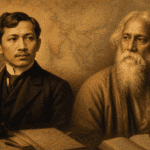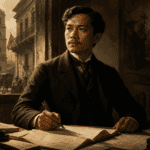
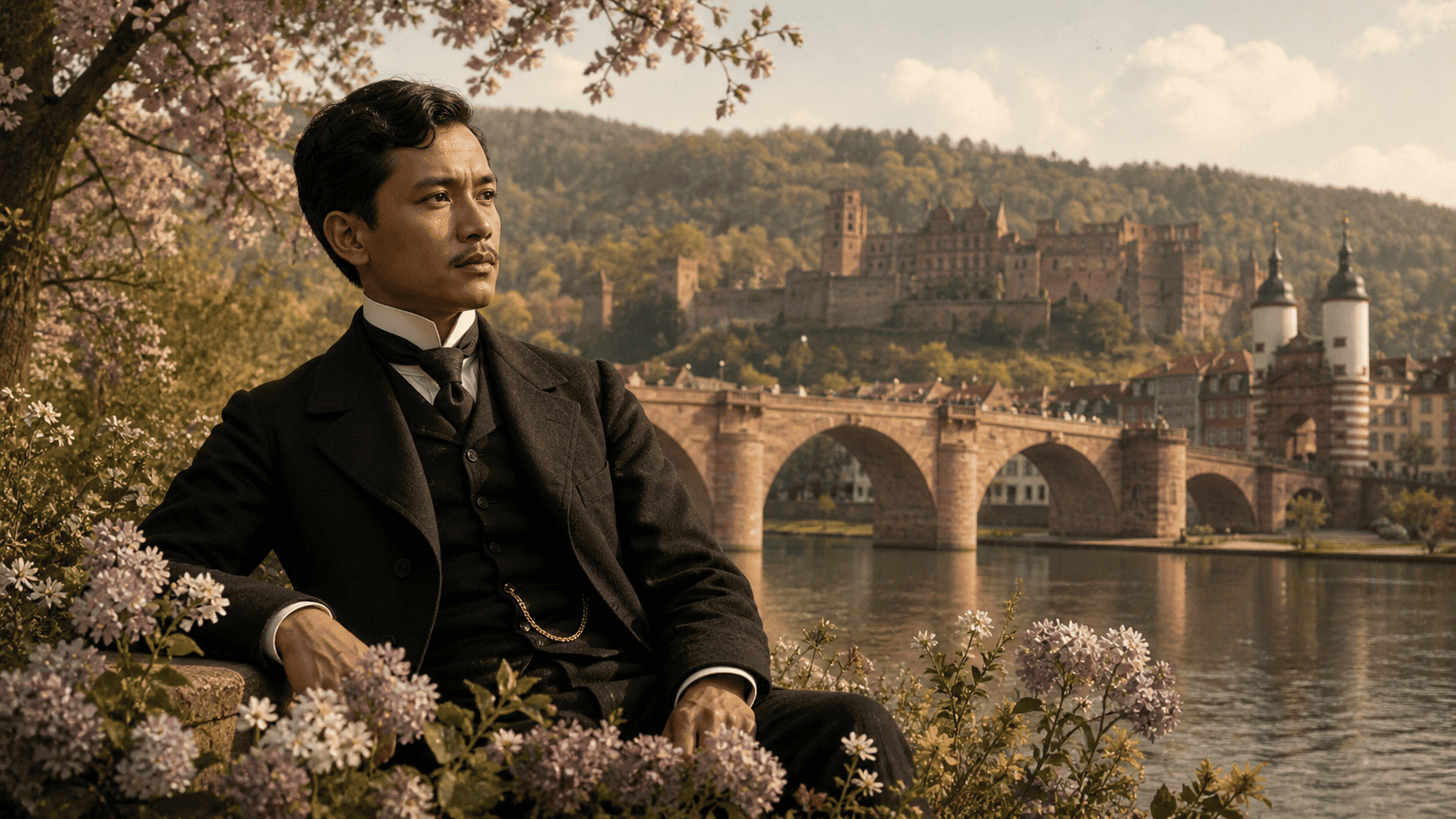
Jose Rizal was studying ophthalmology under Dr. Otto Becker — one of the most respected eye surgeons in Europe — and living the life of a serious medical student: clinics, textbooks, microscopes, the particular discipline of learning to see what the eye cannot quite see.
He was also, in the privacy of the work, homesick.
Background
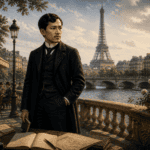
Heidelberg is a city built for longing. The Neckar River runs through it flanked by forested hills; the ruined castle on the Königsstuhl looks down over the old town with the particular melancholy of things that were once grand and are now open to the sky. Spring arrives there with genuine force — the kind of cold-country spring that follows a real winter and makes the flowers feel like a statement.
Rizal had been away from the Philippines since 1882. Four years. He had studied in Madrid, lived in Paris, moved through European capitals with a restless itinerary driven by the twin necessities of learning and economy. He wrote constantly — to his family, to Ferdinand Blumentritt, to fellow Filipino reformists — and the letters make clear that the distance was not comfortable. He was productive in Europe in the way that exiles sometimes are: driven by the knowledge that time is short and the work is serious. But productivity and contentment are not the same thing.
When he saw the flowers blooming along the Neckar that spring, he wrote a poem asking them to carry messages home. To the Flowers of Heidelberg is the result — one of his most personal poems, and one of the most useful for understanding what Rizal was like beneath the political and intellectual project.
The Poem
To the Flowers of Heidelberg (April 1886) English translation
Go to my country, go, O foreign flowers,
sown by the traveler along the road,
and under that blue heaven
that watches over my loved ones,
recount the devotion
the pilgrim nurses for his native sod!
Go and say say that when dawn
opened your chalices for the first time
beside the icy Neckar,
you saw him silent beside you,
thinking of her constant vernal clime.
Say that when dawn
which steals your aroma
was whispering playful love songs to your young
sweet petals, he, too, murmured
canticles of love in his native tongue;
that in the morning when the sun first traces
the topmost peak of Koenigssthul in gold
and with a mild warmth raises
to life again the valley, the glade, the forest,
he hails that sun, still in its dawning,
that in his country in full zenith blazes.
And tell of that day
when he collected you along the way
among the ruins of a feudal castle,
on the banks of the Neckar, or in a forest nook.
Recount the words he said
as, with great care,
between the pages of a worn-out book
he pressed the flexible petals that he took.
Carry, carry, O flowers,
my love to my loved ones,
peace to my country and its fecund loam,
faith to its men and virtue to its women,
health to the gracious beings
that dwell within the sacred paternal home.
When you reach that shore,
deposit the kiss I gave you
on the wings of the wind above
that with the wind it may rove
and I may kiss all that I worship, honor and love!
But O you will arrive there, flowers,
and you will keep perhaps your vivid hues;
but far from your native heroic earth
to which you owe your life and worth,
your fragrances you will lose!
For fragrance is a spirit that never can forsake
and never forgets the sky that saw its birth.
Analysis
The poem works as a letter that cannot be sent by ordinary means, so Rizal invents a different courier. The flowers he finds along the Neckar — blooming beside the icy river in the German spring — become messengers tasked with traveling to the Philippines, finding his family, and delivering the kind of communication that letters cannot quite manage: the evidence that he was there, thinking of them, at a specific moment on a specific morning.
The conceit is sentimental but not weak. What Rizal is doing, in the gesture of pressing flowers into a book and asking them to carry his feeling across the ocean, is acknowledging the basic helplessness of the exile’s situation — you can write letters, but letters cannot show someone what the light looked like on the Königsstuhl, or what it felt like to stand by the Neckar in April thinking of home. The flowers are a substitute for the embodied presence he cannot offer.
The fifth stanza — the list of what he wants the flowers to carry — is the most interesting structurally. He does not simply ask them to carry his love. He asks them to carry peace to his country, faith to its men, virtue to its women, health to his family. The personal request has widened into something that sounds like a prayer for the nation. This is characteristic of Rizal at every register: the private and the political are never fully separable. Even in a homesick love poem, he is thinking about what the Philippines needs.
The final stanzas perform a turn that elevates the poem above simple nostalgia. He acknowledges that the flowers, when they arrive in the Philippines, will have lost their fragrance — that fragrance, unlike color, cannot survive the journey. And then he draws the conclusion: fragrance is a spirit, and spirits do not forget where they were born. The implication is that he is the fragrance — the thing that, however far it travels, retains the essential quality of its origin. He will lose the visible markers of home the longer he is away. He will not lose what home made him.
This is the poem’s real argument, held until the last two lines: that identity survives distance, that what a place puts into a person cannot be taken out by exile, and that the pilgrim standing beside the Neckar in April 1886 is still, at his core, the boy from Calamba.