My First Inspiration — the English title of the Spanish poem Mi Primera Inspiración — is one of the earliest poems Rizal is known to have written, composed during his years at the Ateneo Municipal de Manila when he was approximately fourteen years old.
It was written as a birthday tribute to his mother, Doña Teodora Alonso, and it is the first clear evidence in his surviving work of the literary gifts that would eventually produce two novels and one of the most significant farewell poems of the nineteenth century.
The poem is modest by the standards of what he would later write. But that is precisely what makes it worth reading carefully — not as a great poem, but as a first one: the earliest record of a boy discovering that he could use language to honor someone he loved.
The Poem
Why falls so rich a spray
of fragrance from the bowers
of the balmy flowers
upon this festive day?
Why from woods and vales
do we hear sweet measures ringing
that seem to be the singing
of a choir of nightingales?
Why in the grass below
do birds start at the wind’s noises,
unleashing their honeyed voices
as they hop from bough to bough?
Why should the spring that glows
its crystalline murmur be tuning
to the zephyr’s mellow crooning
as among the flowers it flows?
Why seems to me more endearing,
more fair than on other days,
the dawn’s enchanting face
among red clouds appearing?
The reason, dear mother, is
they feast your day of bloom:
the rose with its perfume,
the bird with its harmonies.
And the spring that rings with laughter
upon this joyful day
with its murmur seems to say:
‘Live happily ever after!’
And from that spring in the grove
now turn to hear the first note
that from my lute I emote
to the impulse of my love.
What the Poem Is Doing
The structure is simple and deliberate. Five stanzas ask the same question in different registers: why does the world feel different today? Why are the flowers more fragrant, the birds more musical, the dawn more beautiful? The natural world seems to be participating in something — but what?
The sixth stanza answers. It is his mother’s birthday. The world is not more beautiful than usual; it only seems that way because she is in it and he is grateful for her. The flowers and birds are not really celebrating anything — but in the mind of a fourteen-year-old boy who loves his mother and has just discovered that he can make language do things, they might as well be.
The final two stanzas complete the movement. The spring’s laughter becomes a blessing — “Live happily ever after!” — and then Rizal turns the poem toward himself. He is about to play the first note from his lute. The impulse that drives the note is love. The poem is, in its final lines, announcing itself: this is what inspiration is, and this is where mine comes from.
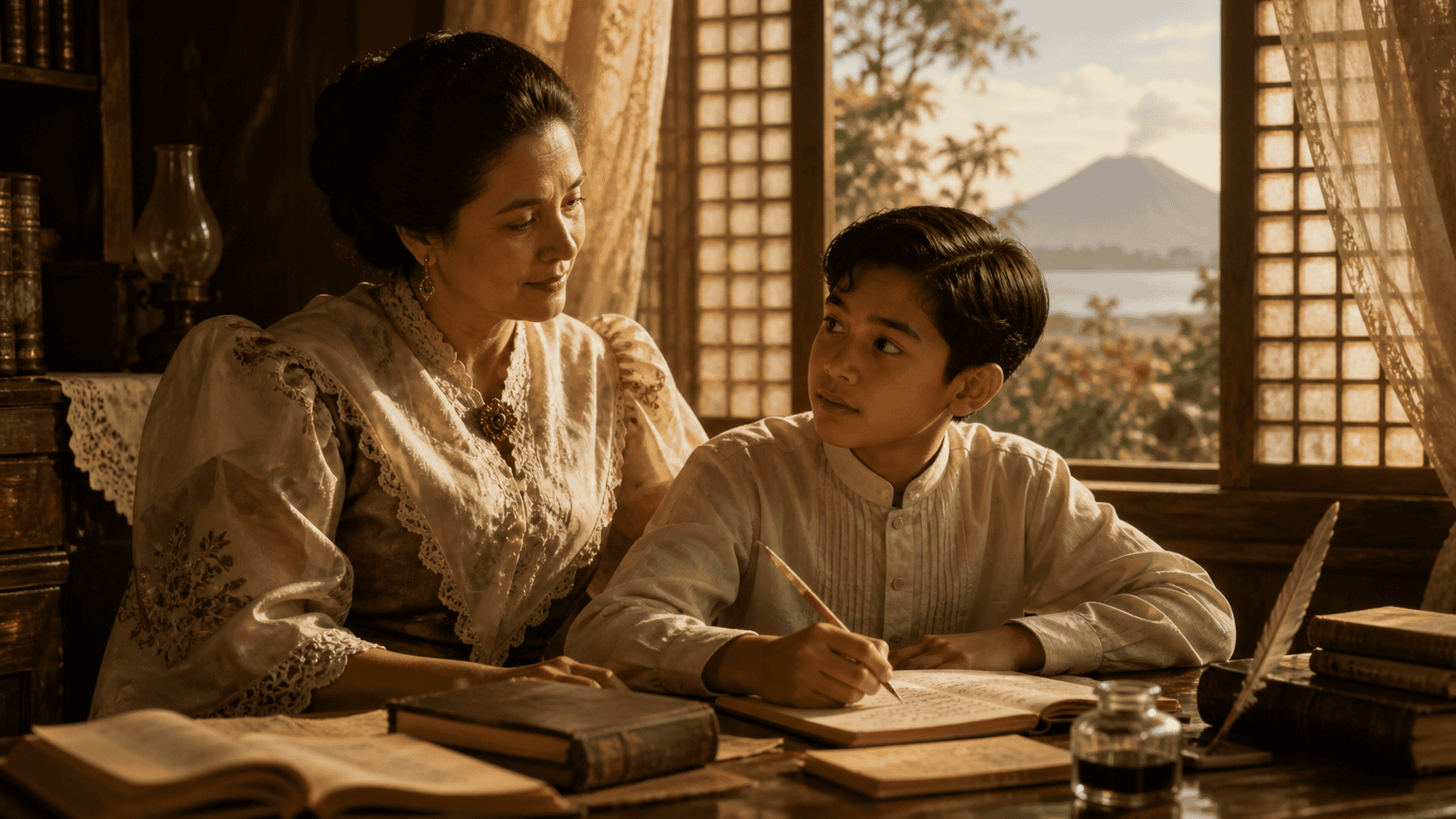
It is a formal gesture — the dedication of an early work to its source — but Rizal means it literally. Teodora Alonso taught him to read before he entered any school. She introduced him to literature, to poetry, to the habit of reflective attention that would define everything he later wrote. The poem’s claim — that she is his first inspiration — is not a conventional compliment but an accurate statement of fact.
The Poem in Context
Teodora Alonso’s influence on Rizal is documented throughout his biography and his own letters. He credited her as his first teacher. Her unjust imprisonment when he was a child — on a fabricated charge that was eventually dismissed — was one of the formative experiences of his early life and appears, transformed, in the maternal figures of his novels. For more on their relationship, see The Imprisonment of Teodora Alonso and What It Made of Rizal.
The poem belongs to the period of his life covered in Rizal’s Education in Manila and Ateneo Years — a period when his Jesuit teachers were encouraging him to write, entering him in competitions, and recognizing in him a student whose gifts exceeded the ordinary curriculum. Father Francisco de Paula Sánchez, who would become the most significant of his Ateneo teachers, was already steering him toward serious literary work by this point.
Mi Primera Inspiración is the earliest surviving evidence of that work paying off. It is not a great poem — Rizal himself would write poems of far greater weight and precision in the years that followed. But it is a genuine one, and in the context of a life spent arguing that education and literature were the foundations on which a people’s dignity could be built, the fact that it is dedicated to the woman who first taught him to read carries its own quiet significance.
For the original Spanish text, see Mi Primera Inspiración. For a guide to Rizal’s poetry across all periods, see The Poems of José Rizal.