
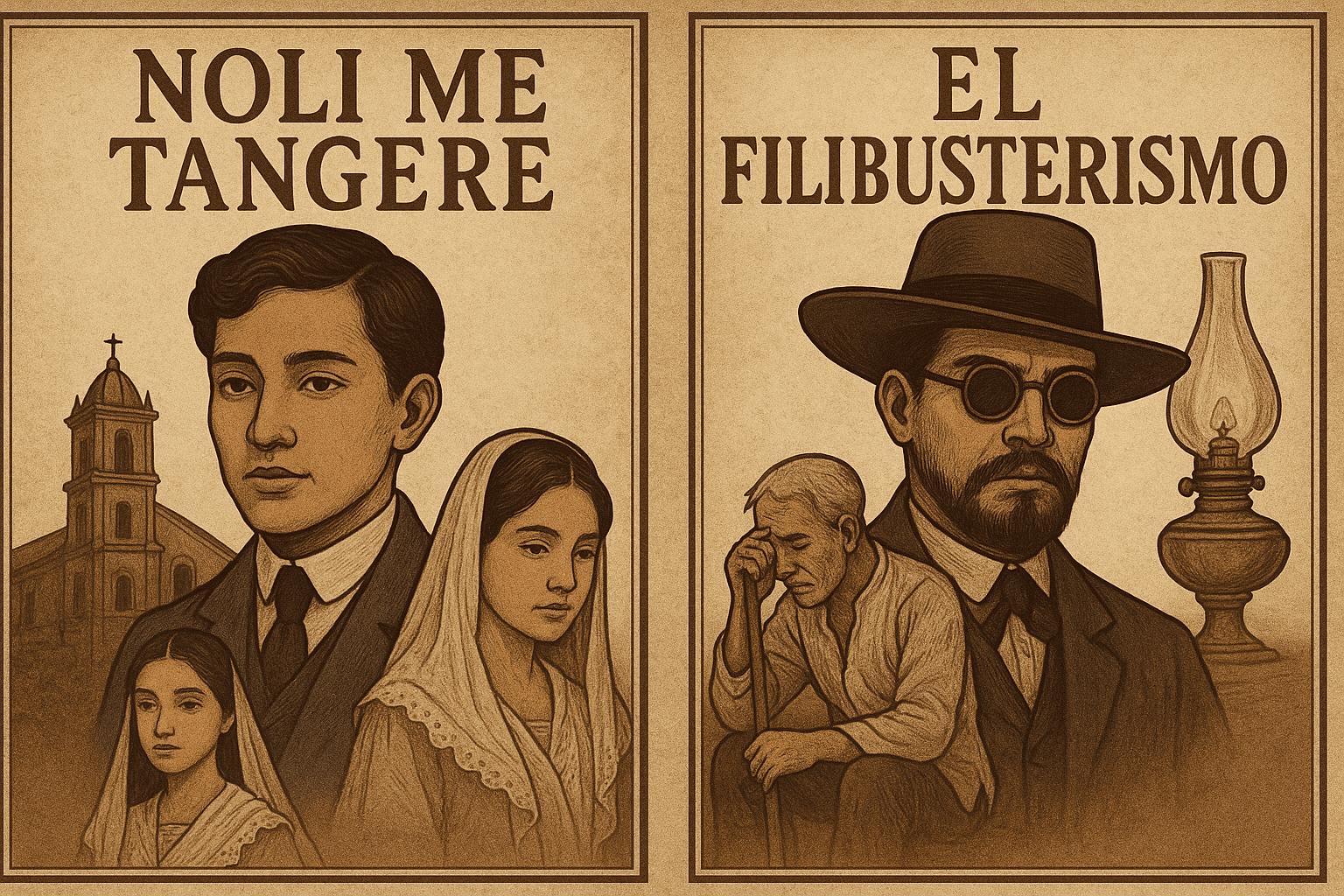
The Same Author, Four Years Apart
Noli Me Tangere was published in Berlin in 1887. El Filibusterismo followed in Ghent in 1891. Four years separated them, but the distance in worldview is enormous.
When Rizal wrote the Noli, he was 26 years old and still believed, with some conviction, that the Spanish colonial government could be persuaded to treat Filipinos fairly. The Propaganda Movement was active, La Solidaridad was publishing, and the argument for peaceful reform still felt like it had somewhere to go.
By 1891, that belief had curdled. His family had been driven off their land in Calamba. Reform-minded Filipinos were being exiled or imprisoned. The colonial government had made clear, repeatedly, that it was not interested in listening. Rizal wrote the Fili in that climate — and it shows on every page.
Understanding this context is the key to understanding why the two novels feel so different. They are not just two chapters of the same story. They are two different answers to the same question: what do you do when your country is suffering?
Tone: Sunrise vs. Long Shadow
The most immediate difference between the two novels is how they feel.
Noli Me Tangere is alive with energy — satirical, romantic, occasionally funny, frequently heartbreaking, but never without the sense that things could be different. Even its darkest scenes carry the implied argument that enlightenment is possible, that education matters, that a society shown its own reflection might choose to change. The novel critiques colonial society, but it still believes in people.
El Filibusterismo does not. Its tone is somber, compressed, almost suffocating. The humor of the Noli is largely gone. In its place is something colder — a novel that has stopped hoping and started calculating. Where the Noli satirizes the friars, the Fili treats them as a structural problem with no obvious solution. Where the Noli ends in tragedy but leaves the future open, the Fili ends with a dying man’s confession and a chest of jewels thrown into the sea.
If the Noli is a sunrise, the Fili is the long shadow cast by a dying sun.
The Central Character: From Ibarra to Simoun
The clearest way to see what changed between the two novels is to look at what happened to their protagonist.
In Noli Me Tangere, Crisóstomo Ibarra is a young man returned from Europe, full of ideas and in love. He wants to build a school. He believes the system can be worked with, that reason and goodwill can produce change. He is idealistic in the way that only someone who hasn’t yet been completely broken can be.
By El Filibusterismo, Ibarra has been broken. He returns as Simoun — disguised behind a beard, dark glasses, and a fabricated identity as a wealthy jeweler. He has spent thirteen years in exile accumulating money, cultivating access to colonial power, and preparing a plan not to reform the system but to detonate it. He doesn’t want to build a school anymore. He wants to blow up a dinner party full of colonial officials and use the explosion as the signal for a coordinated uprising.
This transformation is Rizal’s most powerful statement about what oppression does over time. Ibarra didn’t become Simoun because he was weak or vengeful by nature. He became Simoun because every peaceful option was closed to him, one by one, until nothing remained but rage. The Fili is, among other things, a warning: this is what you create when you refuse to listen.
What Happened to the Other Characters
The supporting cast tells the same story.
María Clara in the Noli is the emotional heart of the novel — tender, constrained by her circumstances, genuinely loved. In the Fili, she is a ghost. Imprisoned in a convent, stripped of everything, she appears briefly and then disappears entirely. She does not get a redemption arc. She simply ends, which is its own kind of statement about what colonial society does to its most vulnerable.
Basilio, the traumatized child of the Noli — the boy who lost his brother to the church’s cruelty and his mother to grief — has grown into a medical student by the Fili. Intelligent, disciplined, trying to build a life from nothing. He becomes Simoun’s chosen confidant, the person offered a place in the revolutionary plan. His hesitation — between the desire for justice and the fear of what violence costs — is one of the Fili‘s most honest portrayals of the impossible position the colonial system put ordinary Filipinos in.
Elias, who dies in the Noli with a vision of a freer future, is echoed in the Fili by Kabesang Tales — a farmer whose land is taken, who petitions, who waits, who is ignored, and who eventually joins the outlaws in the mountains. He is not a revolutionary by conviction. He is a man who ran out of other options. Rizal draws a direct line from injustice to radicalism, and refuses to pretend that line is anything other than what it is.
Themes: Reform vs. The Limits of Reform
Noli Me Tangere is built around the belief that reform is possible. Its themes — education, moral awakening, the exposure of hypocrisy — all point toward the same implicit argument: if people can be made to see clearly, things can change. Ibarra’s school project is the novel’s central symbol. It is modest, practical, achievable. It asks only that the system allow one small good thing to exist.
The system destroys it anyway. And El Filibusterismo begins from that wreckage.
The Fili‘s themes are darker: the corruption of power, the futility of petition, the seduction of revenge, the question of whether violence can ever produce genuine freedom. Rizal does not answer that last question simply. Simoun’s plan fails — spectacularly, accidentally, because of a young man’s impulsive love for a woman who chose someone else. But the novel doesn’t present the failure as proof that Simoun was wrong to try. It presents it as proof that revolution without moral foundation cannot succeed. The question of what revolution with moral foundation might look like is left open.
Satire vs. Political Allegory
Noli Me Tangere uses humor as a weapon. Doña Victorina’s social pretensions, the bureaucratic absurdity of colonial governance, the pomposity of minor officials — Rizal satirizes these with the precision of someone who has studied the target carefully and finds it, beneath the outrage, genuinely ridiculous. Satire assumes the audience can be made to see the joke. It assumes a shared capacity for embarrassment. It is, at its core, an optimistic form.
El Filibusterismo largely abandons satire. The comedy has drained out. In its place is allegory — the lamp that Simoun plans to use as a bomb, the jewels that represent wealth built on suffering, the wedding celebration that becomes the target of a revolutionary attack. Everything in the Fili means something beyond itself. Where the Noli holds up a mirror, the Fili holds up a warning sign.
Religion
In the Noli, Rizal’s critique of the Catholic Church is sharp but not total. He attacks the friars — their hypocrisy, their corruption, their abuse of power — but leaves space for genuine faith. Padre Florentino, who appears briefly in the Noli and more significantly in the Fili, embodies the possibility of religion as a moral force rather than an instrument of control.
In the Fili, that distinction narrows. The institutional church is portrayed as so thoroughly captured by colonial power that it has become indistinguishable from it. Religion is not a comfort here — it is a mechanism, used to pacify people who might otherwise demand their rights. The Fili‘s treatment of religion is not atheism, but it is something close to despair about what organized religious power does when left unchecked.
Structure and Pacing
Noli Me Tangere is expansive. It moves across multiple storylines, multiple social classes, multiple settings — from dinner parties to forests to courtrooms to convents. It is a panoramic novel, trying to capture an entire society in cross-section. It takes its time. It has room for digression, for comic scenes, for extended portraits of minor characters who never appear again.
El Filibusterismo is tighter and more propulsive. It is structured almost like a thriller — every scene pushes toward the climactic moment of the lamp and the failed explosion. There is less room for digression because the novel’s emotional logic doesn’t allow it. Everything is building toward something, and the reader feels that pressure accumulating.
The structural difference mirrors the thematic one. The Noli has time. The Fili does not.
What Rizal Was Actually Saying
A common misreading of the two novels treats the Fili as Rizal endorsing revolution. It doesn’t. Simoun’s plan fails. His dying confession to Padre Florentino is not triumphant — it is exhausted, sorrowful, a reckoning with what rage without wisdom produces.
But the Fili is equally not a rejection of revolution. What it rejects is a specific kind of revolution: one driven by personal vengeance, one that treats human suffering as strategic material, one that has no moral foundation beyond the desire to destroy. Rizal’s argument is not that Filipinos should accept their situation. It is that the manner of resistance matters as much as the fact of it.
Together, the two novels form a complete position. The Noli says: here is what is wrong, and here is what education, truth-telling, and moral courage can do about it. The Fili says: when those tools are taken away or prove insufficient, the pressure builds toward something more explosive — and that explosion, if it comes, must be guided by something better than hatred, or it will simply replace one form of oppression with another.
Rizal wrote both novels before he was 30. He was executed at 35. The revolution began the same year.
Reading Them Together
Most students encounter the Noli and the Fili separately, often in abridged versions, often with the politics sanded down into something safer. Read together, in full, they are something different: a two-volume argument about freedom, justice, and the cost of telling the truth in a society that punishes it.
The Noli reveals what is wrong. The Fili reveals what happens when those wrongs are left unaddressed. Between them, they contain most of what Rizal believed — about colonialism, about violence, about the kind of people a nation needs to produce if it wants to govern itself with dignity.
They remain, 130 years later, the most important novels ever written about the Philippines. And for readers coming to them fresh, without the weight of school assignments and national mythology, they are also simply excellent — sharp, human, and more alive than most fiction written in their era.
Read the full summaries: Noli Me Tangere · El Filibusterismo Go deeper: Noli Me Tangere Analysis · El Filibusterismo Analysis