The Arrest
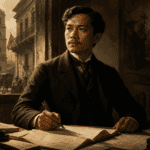
In the summer of 1896, Rizal was living in Dapitan, four years into his exile, when the Katipunan’s existence was discovered by Spanish authorities and the revolution broke out across the provinces. He was not in Manila. He was not organizing. He was, at that moment, aboard a ship in the Mediterranean, having received official permission to travel to Cuba to serve as a volunteer military doctor.
The Spanish authorities intercepted him at Barcelona. He was taken off the ship, held briefly, and then shipped back to Manila on the steamer Colon, arriving on November 3, 1896. He was transferred immediately to Fort Santiago, the colonial military prison at the mouth of the Pasig River, where he was placed in a cell and subjected to interrogation.
The charge against him was sedition — specifically, that his writings had inspired the Katipunan and that he was therefore morally and legally responsible for the uprising. No evidence placed him in contact with the Katipunan’s leadership. No document showed him organizing, funding, or directing the rebellion. The prosecution’s case rested almost entirely on the novels and essays he had published years earlier, and on the testimony of witnesses who named him as an influence without being able to demonstrate conspiracy.
The Trial
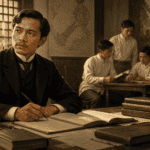
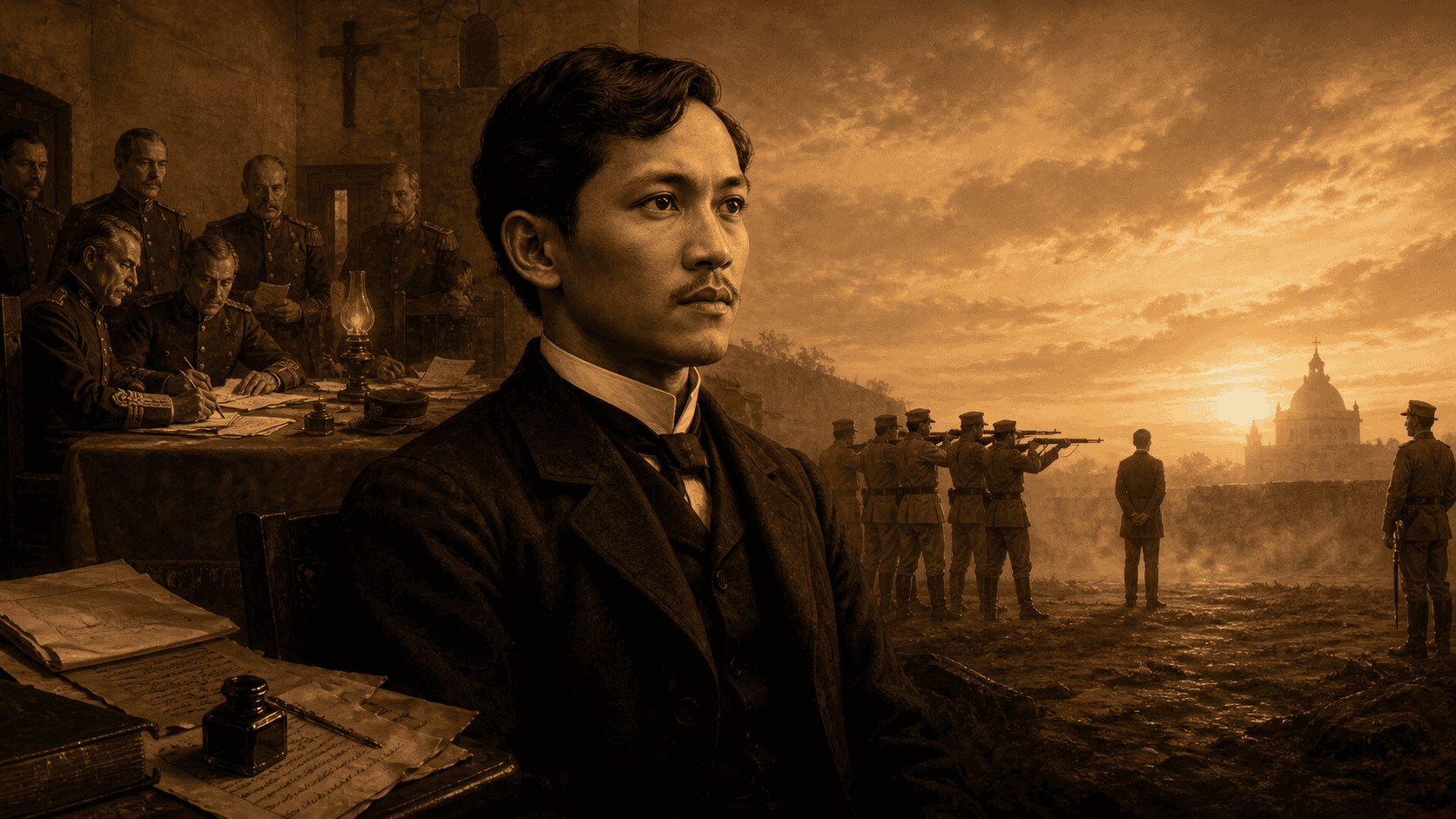
The military trial of José Rizal opened on December 26, 1896, and concluded on December 28. Four days from first session to verdict — in a case that the prosecution characterized as one of the gravest in the history of the colony.
The presiding judge was a Spanish military officer. The charges were rebellion, sedition, and forming illegal associations. Rizal was permitted a defense counsel, a Spanish lieutenant named Luis Taviel de Andrade, whose brother had once served as Rizal’s personal bodyguard in Calamba and who approached his assignment with genuine seriousness. Taviel de Andrade argued that the evidence was circumstantial, that influence was not conspiracy, and that a man who had explicitly and repeatedly argued against premature armed uprising could not be held responsible for an uprising he had tried to prevent.
Rizal conducted his own defense with the same precision he brought to everything. He denied membership in the Katipunan. He denied organizing or funding the rebellion. He acknowledged that his novels had been widely read and that he had criticized Spanish colonial administration — but he argued that literary criticism and political agitation were not the same thing, and that a government that could not distinguish between a novelist and a rebel deserved neither the novelist’s respect nor the world’s.
He was composed throughout. Witnesses who saw him during the proceedings described a man who appeared calmer than his accusers — who took notes, asked careful questions, and conducted himself with the dignity of someone who understood that the verdict had already been decided and had chosen to use the trial as a final record of his actual position.
The guilty verdict was delivered on December 28. Governor-General Camilo de Polavieja signed the death warrant the same day. Execution was set for the morning of December 30.
The Last Night
Rizal spent December 29 in his cell at Fort Santiago. He was permitted visits from family members — his mother Teodora, his sisters, and Josephine Bracken, the Irish-born woman he had met in Dapitan and married in a civil ceremony in the hours before his execution. He was calm. The witnesses who described that evening — the guards, the priests, the family members allowed inside — consistently used the same word: serene.
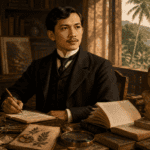
He wrote. He wrote farewell letters to his family, to his brother Paciano, to his friend Ferdinand Blumentritt in Austria. He composed a final poem — fourteen stanzas in Spanish, addressed to the Philippines, to the generations not yet born, to the country he had spent his adult life trying to serve. He did not give the poem a title. He folded it carefully and concealed it inside a small alcohol stove, which he gave to his sister Trinidad as she was leaving. If they search you, he told her, there is something inside.
The poem was recovered, copied, and circulated within days of his death. It became known as Mi Último Adiós — My Last Farewell — and remains one of the most widely read poems in the history of Philippine literature.
He also, in those final hours, formally married Josephine Bracken. The ceremony was performed by a priest in the cell. It was one of the last acts of a man who had been accused of undermining the institutions of colonial society — marrying, in a Catholic ceremony, the woman he loved, on the night before his execution.
The Morning of December 30
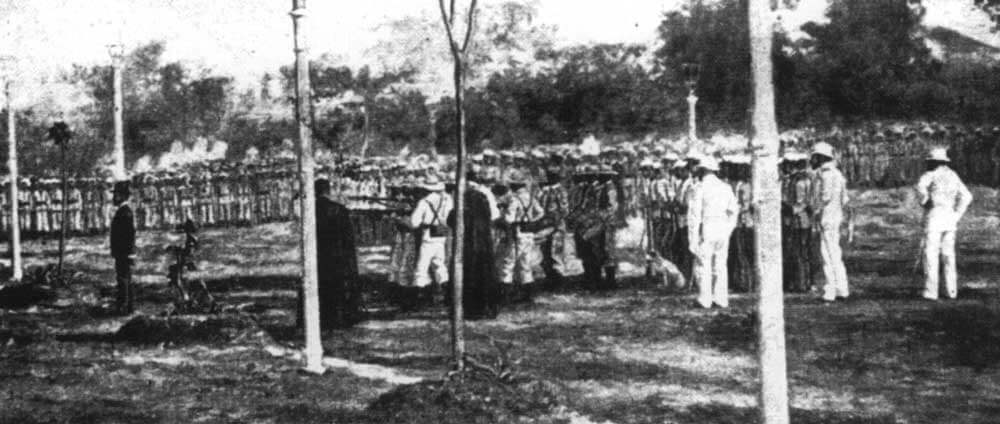
At dawn, Rizal was escorted from Fort Santiago to Bagumbayan Field — the open ground facing Manila Bay that the Spanish colonial government used for public executions. It is now called Rizal Park. The walk took him through streets that were quiet in the early morning, past walls that bore no proclamations, past a city that did not yet know what was about to happen.
He walked without being bound at the elbows, which was the customary treatment of condemned prisoners. He had asked to be shot facing the firing squad — a privilege typically accorded to soldiers rather than convicted traitors. The request was denied. He was ordered to stand with his back to the line of soldiers.
As the order was given and the shots fired, witnesses reported that Rizal twisted his body in the moment of impact, turning so that he fell facing upward, toward the sky and the rising sun over Manila Bay. Whether this was a final deliberate act or an involuntary response to the impact of the bullets, it became one of the most discussed details of his death — a last image that the colonial government had not scripted and could not control.
He was 35 years old.
What the Government Had Miscalculated
Governor-General Polavieja believed the execution would accomplish two things: remove the most influential voice of the reform movement, and demonstrate to the wider Filipino population that opposition to Spanish rule carried consequences severe enough to discourage further resistance.
It accomplished neither.
News of the execution spread from Manila outward through the provinces within days. The response was not fear. It was fury — and, more dangerously for the colonial government, a unifying fury that crossed the lines of class and region that had previously divided the independence movement. The ilustrados who had followed Rizal’s gradualist path and the Katipuneros who had rejected it as insufficient found themselves, for the first time, united in something that required no political theory to sustain: the shared recognition that Spain had just executed a man who had asked, peacefully and eloquently, for nothing more than justice.
Provincial uprisings that had been faltering gained momentum. Families that had been waiting out the conflict chose sides. The Katipunan, which had been struggling to maintain cohesion after the revolution’s early reverses, found in Rizal’s death a symbol capable of holding the movement together through the difficult months that followed.
Mi Último Adiós, circulating in handwritten copies and whispered translations, did what Polavieja’s death warrant had been intended to prevent: it made Rizal more present in the minds of Filipinos after his death than he had ever been in life.
December 30
Rizal Day — December 30 — is a national holiday in the Philippines. The date marks not only his death but the specific quality of that death: the clarity with which it exposed what the colonial government actually was, beneath the language of civilization and Christian mission that it used to justify itself.
The trial lasted four days. The deliberation that produced the guilty verdict took less than an hour. The man executed at Bagumbayan had been convicted, in the end, of writing two novels and believing that the Philippines deserved better than what it had.
Spain lost the Philippines two years later.
Read next: Mi Último Adiós — the poem Rizal wrote the night before his execution, hidden in an alcohol stove, and what it actually says.