Josephine Bracken had traveled from Hong Kong accompanying her ailing stepfather, George Taufer, who had heard of a Filipino doctor in exile whose skill with eyes was extraordinary. Taufer had double cataracts that no ophthalmologist in Hong Kong could treat. The journey to a small coastal town in Mindanao was a long one for something that might not work.
It worked. And Josephine stayed.
The Circumstances of the Poem
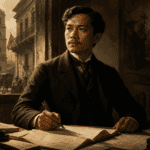
Rizal was thirty-three years old and three years into his exile in Dapitan when they met. He had built a school, a clinic, and a water system for the town. He had been collecting specimens and sending them to European scientific institutions. He had written letters to Blumentritt, to his family, to anyone who would keep the correspondence alive across the distance. Dapitan was productive, but it was also isolated — a posting designed to keep him far from Manila and further from Europe.
Josephine Bracken was eighteen, Irish by ancestry, born in Hong Kong, and raised by Taufer after her mother died in childbirth and her father, a soldier, could not care for her. She was, by most accounts, neither highly educated nor politically formed — nothing like the ilustrado world Rizal inhabited. What she was, apparently, was present, warm, and willing to stay in a place most people were trying to leave.
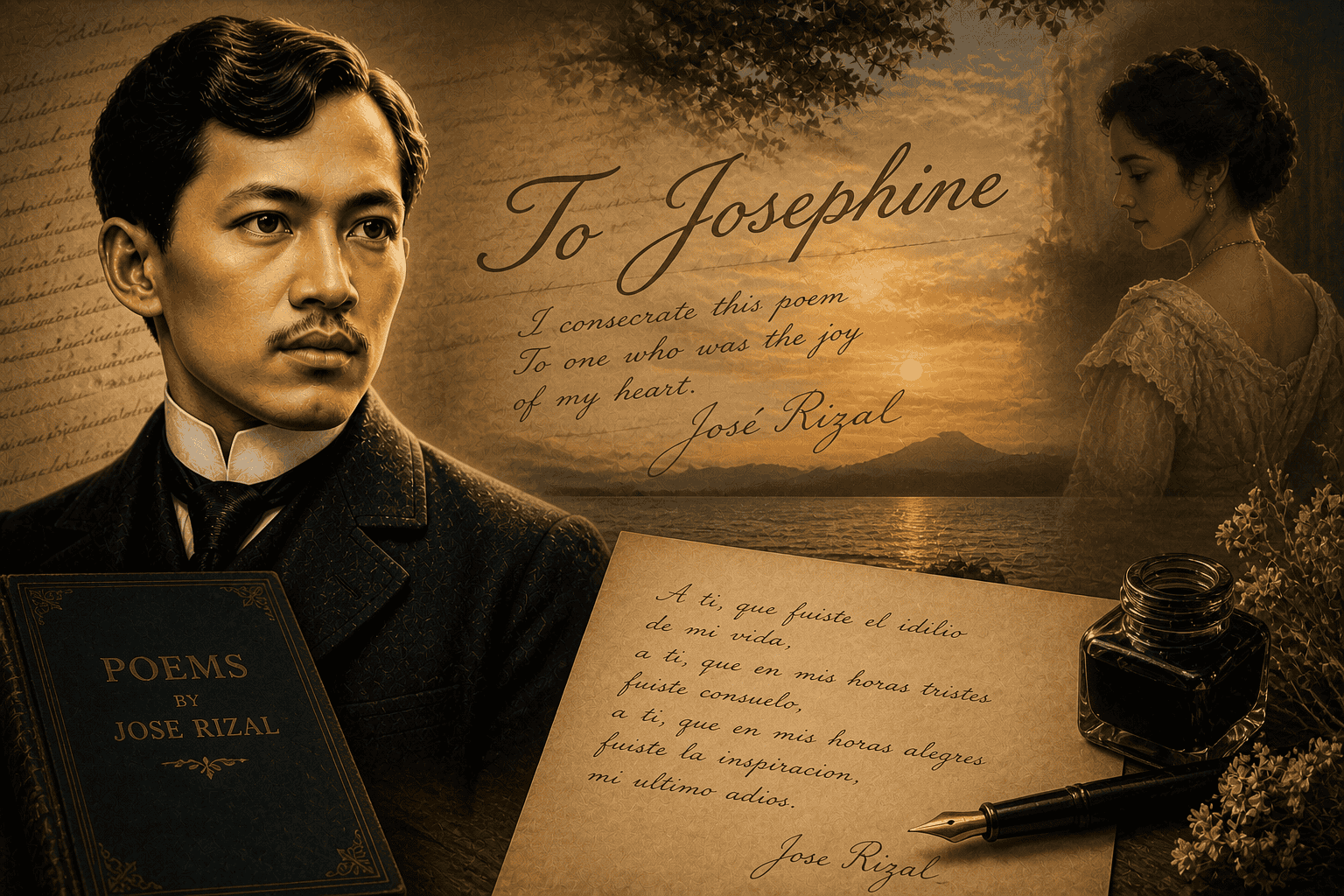
Rizal fell in love quickly. When Taufer’s treatment was complete and departure became necessary, the stepfather’s reaction was extreme — threatening self-harm at the prospect of losing Josephine, requiring Rizal himself to intervene physically. Josephine returned to Manila with Taufer. Rizal wrote the poem before they parted — or shortly after — as a way of saying what he could not fully say aloud: that if her life took her elsewhere, to Japan or China or Shanghai, he would be here, and his heart would still be pointing toward her.
Six months later, Josephine came back.
The Poem
To Josephine (c. 1895)
Josephine, Josephine
Who to these shores have come
Looking for a nest, a home,
Like a wandering swallow;
If your fate is taking you
To Japan, China or Shanghai,
Don’t forget that on these shores
A heart for you beats high.
What the Poem Does
It is a short poem — eight lines, simple rhyme, direct address. It does not attempt the formal complexity of Mi Último Adiós or the political weight of A la Juventud Filipina. It is a love poem written by a man in exile to a woman who is leaving, and its power comes entirely from its circumstances rather than its craft.
The central image — Josephine as a wandering swallow looking for a nest, a home — is both tender and precise. Josephine was, in fact, rootless in the way the image suggests: orphaned in infancy, adopted, moved between Hong Kong and Manila and Mindanao on other people’s plans. A swallow is a bird of passage, always in motion, belonging to no particular shore. Rizal is offering her one — his shore, his coast, his heart — without demanding that she take it.
The ending is a statement, not a plea. Not “please come back” but “don’t forget that a heart beats here.” It is the restraint of someone who understood that love cannot be compelled, only offered — and that offering it clearly was enough.
What Came After
Josephine returned to Dapitan in late 1895. They attempted to marry through the Church — the local priest, Father Antonio Obach, refused to perform the ceremony without a special dispensation from the Bishop of Cebu, citing the fact that Rizal was a Mason and Josephine a Catholic. The dispensation was not granted. They married before two witnesses instead, without priestly blessing — a decision that reflected Rizal’s unwillingness to meet the Church’s precondition, which involved a retraction of his reform positions.
They lived together in Dapitan until Rizal left for Cuba in July 1896. Josephine traveled with him as far as Manila. Their child — born prematurely during the Dapitan years — did not survive.
When Rizal was imprisoned at Fort Santiago and faced execution, Josephine was brought to his cell for a final visit. A civil marriage ceremony was performed on the morning of December 30, 1896, hours before the firing squad. He gave her a small book — a copy of Thomas à Kempis’ Imitation of Christ — inscribed “to my dear and unhappy wife Josephine.”
In his final poem, Mi Último Adiós, written the night before his execution, he addressed her directly in the last stanza: Adiós, dulce extranjera, mi amiga, mi alegría — Farewell, sweet foreigner, my darling, my delight.
She outlived him by six years, dying of tuberculosis in Hong Kong in 1902 at twenty-five years old. She was buried in an unmarked grave.
The wandering swallow never quite found a shore to stay on. But she had been the poem, and the inscription, and the final stanza — and that is its own kind of permanence.
Read more about Josephine Bracken and Mi Último Adiós.