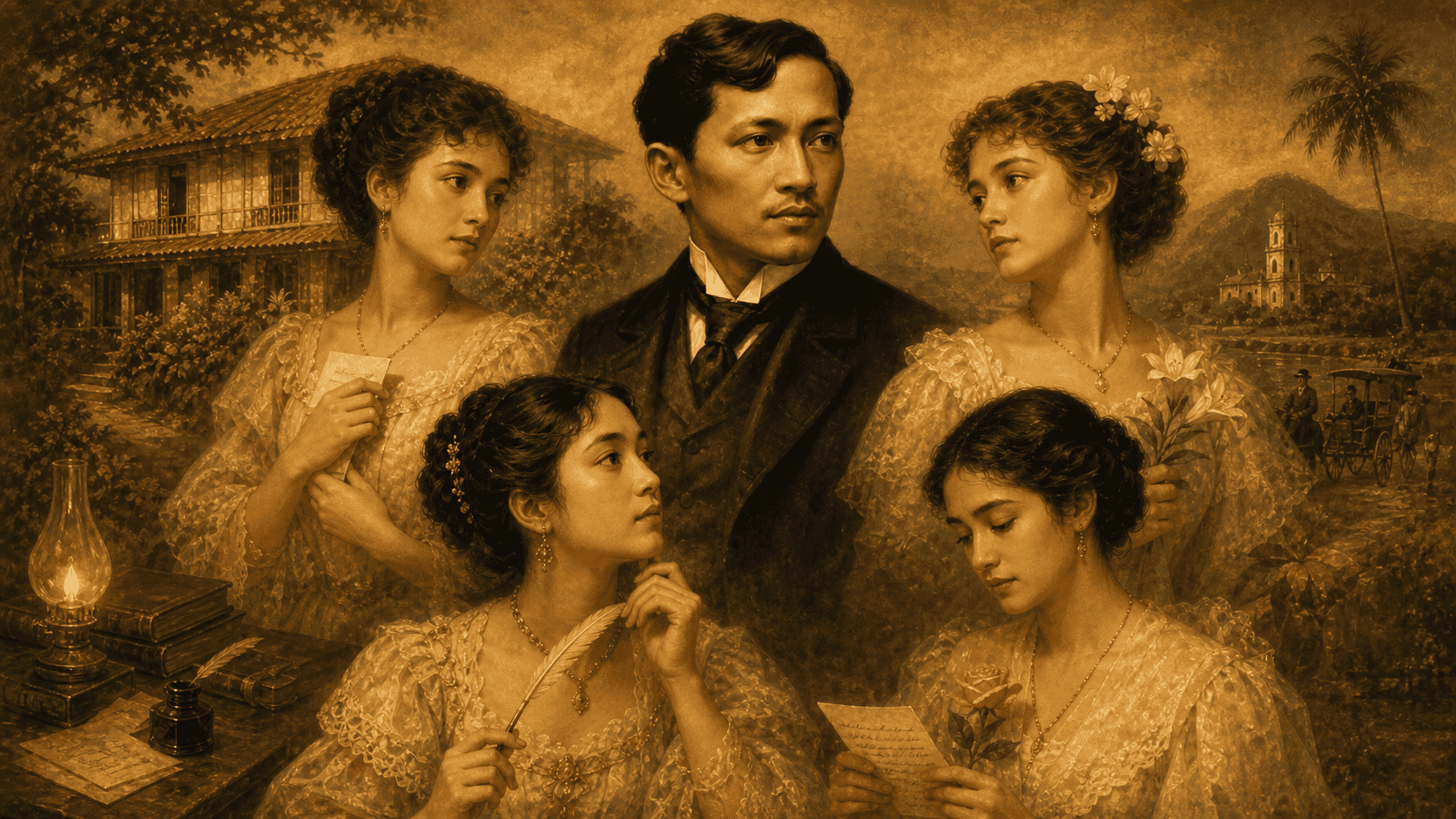
Rizal’s emotional life is one of the least examined aspects of his biography, which is strange given how much it shaped his writing. The women he loved — and the women who loved him — appear throughout his novels in ways that are sometimes idealized, sometimes melancholy, and occasionally more honest about the constraints of colonial society than any of his essays. To read about these relationships is not simply to satisfy biographical curiosity. It is to understand something important about how Rizal thought about love, loyalty, duty, and the kind of life he might have lived if history had arranged itself differently.
He was not a man who loved carelessly. He was also not a man who found it easy to choose between the personal and the political — and in most of his significant relationships, that tension never fully resolved.
Segunda Katigbak
Rizal was sixteen when he met Segunda Katigbak in 1877, and everything about the encounter has the quality of a first love: intense, brief, and slightly unreal in retrospect. She was from Lipa, Batangas — intelligent, quietly charming, already engaged to someone else. That last detail did not stop Rizal from falling for her, though it did prevent anything from coming of it.
What is worth noting about the Katigbak episode is not the romance itself but what Rizal did with it afterward. He wrote about it with unusual clarity in his memoirs — no dramatization, no bitterness, just a precise account of what he felt and why it could not go anywhere. The capacity for honest self-examination that would later make his novels so precise is already visible here, in a teenager processing his first heartbreak.
Leonor Valenzuela
During his years at the University of Santo Tomas, Rizal courted Leonor Valenzuela — known to friends as Orang — with the inventiveness of someone who found ordinary courtship insufficiently interesting. He wrote her letters in invisible ink made from table salt and water, which had to be held over a lamp to read. It is one of the more charming details in his biography.
The relationship was light rather than deep — affectionate but without the weight that characterized his later attachments. When Rizal left for Europe in 1882, the connection faded without apparent drama on either side. Orang’s place in the story is less about what she meant to him than about what she reveals: that even as a young man, Rizal brought the same creativity and attention to his personal life that he brought to everything else.
Leonor Rivera
No account of the women in Rizal’s life can spend equal time on all of them, because Leonor Rivera is simply not equal to the others in terms of what she meant to him or what her story costs the reader to sit with. She was the central romantic relationship of his adult life, and it ended badly — not through any failure on her part or his, but through the sustained interference of her mother and the cruel geometry of distance and silence.
They had known each other since childhood. By the time Rizal left for Europe, they were understood between themselves to be committed to each other — no formal engagement, because the circumstances did not permit it, but a clear mutual understanding. They wrote constantly. He sent letters from Madrid, Paris, London, Berlin. She replied from Manila, in letters that her mother increasingly intercepted and withheld.
Rivera waited eleven years. That is not a small thing. She waited through Rizal’s first return to the Philippines, his second exile, his growing political danger, and the long silences that her mother engineered. By the time she finally accepted the proposal of Henry Kipping, an English engineer, she had been given every reason to believe that Rizal had forgotten her or moved on. He had not. When he learned of her marriage, the accounts of his friends describe a grief he carried quietly but did not quickly put down.
She became María Clara in Noli Me Tangere — idealized, sheltered, constrained by the expectations of a society that had decided for her what her life should look like. It is not entirely a flattering portrait, and it may not have been entirely intended as one. Rizal understood, at some level, that the social structures he was writing against were the same structures that had taken Rivera from him.
Consuelo Ortiga y Rey
In Madrid, Rizal moved within a circle of Filipino expatriates and Spanish liberals, and it was in that world that he became close to Consuelo Ortiga y Rey, the daughter of a prominent Madrid family. She was cultured, warm, and genuinely drawn to him. He was drawn to her in return — enough to write her a poem, “A la Señorita C. O. y R.,” that survives as one of the traces of the friendship.
What stopped anything from developing was Rizal’s awareness that his friend Eduardo de Lete was also in love with Consuelo. He stepped back. Whether this was nobility or avoidance is a question his biographers have not fully settled — he was still, at this point, holding on to the idea of Rivera, and it is possible that his principled withdrawal from Consuelo served his emotional caution as much as his loyalty to his friend. What is clear is that the parting was graceful, the poem survives, and the friendship did not collapse under the weight of what was unspoken.
O-Sei-San
Rizal spent a month and a half in Japan in 1888, on his way from the Philippines to Europe, and by his own account it was among the happiest periods of his life. The person most responsible for that happiness was O-Sei-San — Seiko Usui — the daughter of a Japanese teacher, educated, refined, and possessed of the kind of quiet intelligence that Rizal found irresistible.
He learned enough Japanese to have real conversations with her. He sketched her. He wrote about her in terms that are unusually unguarded for a man who was generally careful about what he committed to paper. He said, simply, that he loved her — and that leaving Japan meant leaving behind someone he did not want to leave.
He left anyway. The Philippines was waiting, Noli Me Tangere was about to be published, and the political work he had committed himself to did not allow for the life he might have chosen in Yokohama. It is one of several moments in his biography where the cost of his mission becomes personal and specific rather than abstract.
Gertrude Beckett
During his year in London, Rizal lodged with the Beckett family, and the second daughter, Gertrude — known as Gettie — fell in love with him. She was affectionate, attentive to his work, and clearly hoped for something more permanent than a boarder’s relationship. Rizal was fond of her and treated her with genuine kindness, but he did not return her feelings in the same register.
When he left London, he gave her a carved bust and a small painting — thoughtful gifts that carried the weight of a gentle, clear goodbye. The gesture was characteristic: Rizal was not capable of cruelty in his personal relationships, even when he was the one walking away. Whether Gettie found that easier or harder is not recorded.
Nellie Boustead
Of all the relationships after Rivera, the one with Nellie Boustead came closest to a real future. She was the daughter of a wealthy Filipina mother and an English businessman, educated and genuinely his intellectual equal — willing to argue with him about politics, religion, and the shape of the world. He found that quality rare and attractive, as he always had.
They came close to an engagement. The obstacle was religious: Nellie’s family was Protestant and wanted Rizal to convert. He refused, not out of rigidity — he was not a conventionally devout man — but out of a principled unwillingness to make a change of that significance under pressure, for reasons he did not personally feel. Their parting was cordial. It was also, reading between the lines, a relief for a man who was still not entirely free of grief for Rivera and perhaps not ready, whatever he might have told himself, to start over.
Josephine Bracken
Josephine Bracken arrived in Dapitan in early 1895 with her stepfather, George Taufer, who had come from Hong Kong seeking treatment for his deteriorating eyesight. Rizal treated Taufer and, in the process, came to know Josephine — Irish-Filipino by origin, raised in Hong Kong, practical and warm in a way that suited the particular circumstances of exile.
What developed between them was different from anything that had come before. It was not the romantic intensity of Rivera, or the cultural enchantment of O-Sei-San, or the almost-engagement of Nellie Boustead. It was companionship — chosen, deliberate, and sustained through conditions that would have broken less committed people. They lost a premature infant. They were refused a church marriage because the local priest would not act without permissions that were never going to be granted. They exchanged private vows instead and built a life together within the limits of what Rizal’s exile allowed.
Josephine was with him in the final days before his execution. She visited him in Fort Santiago. Their last meeting was, by the accounts that survive it, quiet — two people who knew what was coming and had already said what needed to be said. After his death she worked as a nurse in the Philippine Revolution, the same revolution his death had helped set in motion. She was twenty-three when he was executed. She outlived him by several decades, though the historical record loses track of her with a casualness that is its own kind of injustice.
What These Relationships Reveal
The women in Rizal’s life are not simply a list of romantic interests, though they are sometimes treated that way. They are a record of a man trying, repeatedly and with genuine feeling, to build something personal in the middle of a life that kept demanding that the personal be subordinated to the political.
He did not always make the right choices. He left O-Sei-San in Japan because the Philippines needed him. He may have held on to Rivera longer than was fair to the women who came after her. He was capable of the kind of emotional compartmentalization that a life of political exile tends to produce in people who survive it.
But he was also, by every account that survives, a man who treated the women he loved with respect and honesty — who did not exploit admiration, who stepped back when he saw that staying would cause harm, and who was capable of real grief when love did not survive the circumstances surrounding it.
That is not a small thing, either.
For the full story of Rizal’s life, see the complete biography and the complete timeline.