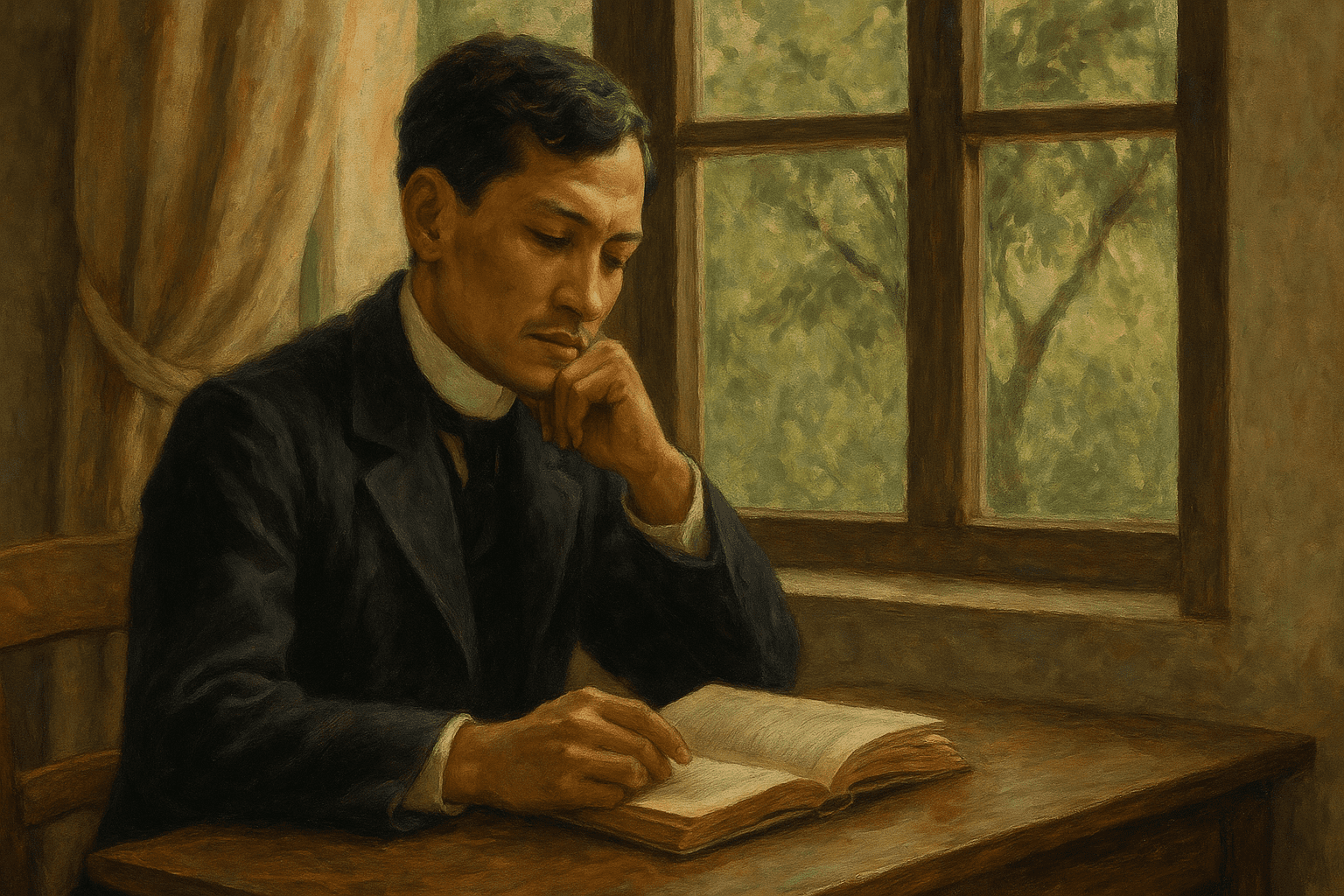
In 1887, a 26-year-old Filipino doctor living in Berlin finished a novel he had been writing in secret. He called it Noli Me Tangere — Latin for “Touch Me Not,” the words Christ spoke to Mary Magdalene after the resurrection. He chose the title deliberately. The wounds he was writing about, he was saying, were too raw, too infected, too dangerous to touch.
The Spanish colonial government in the Philippines agreed. They banned it immediately.
Filipinos read it anyway — in secret, passed hand to hand, copied by candlelight. And when they did, many of them felt, for the first time, that someone had told the truth about their lives.
This is the story that novel tells.
The World of the Novel: What You Need to Know First
If you’re coming to Noli Me Tangere without any knowledge of Philippine history, one fact unlocks everything else: by the time this novel was written, Spain had controlled the Philippines for more than 300 years.
That is not an abstraction. Three centuries of colonial rule meant that the Catholic Church and the colonial government had fused into a single system of power. Priests — called friars — didn’t just run parishes. They owned land, controlled schools, influenced courts, and reported dissidents to the authorities. Filipinos, regardless of education or wealth, were treated as subjects rather than citizens. The word used for indigenous Filipinos was indio — a term loaded with contempt.
Into this world, Rizal dropped a novel about what it actually felt like to live there.
Part One: The Man Who Came Home With Hope
The novel opens at a dinner party in Manila, hosted by a wealthy Filipino named Kapitan Tiago. His home is full of the usual guests — Spanish officials, friars, foreign merchants, and a handful of Filipinos careful to say nothing that might offend anyone in power.
Into this gathering walks Crisóstomo Ibarra — young, educated, recently returned from seven years of study in Europe. He is optimistic in the way that only someone who has been away for a long time can be: full of ideas, full of plans, still believing that the right intentions can move the world.
He is also in love. María Clara, Kapitan Tiago’s daughter, has been waiting for him. Their relationship — tender, chaste, built on years of letters and childhood memory — is the emotional heart of the novel. She is beautiful, gentle, and deeply constrained by the expectations of colonial society. He is earnest and idealistic. Together they represent everything that might have been possible, in a different world.
But Ibarra has come home to a different world than the one he imagined.
Part Two: What Happens to a Man When He Learns the Truth
The first blow comes quickly. Ibarra asks about his father — Don Rafael Ibarra, once a respected man in the town of San Diego. The answer he receives is devastating.
Don Rafael, it turns out, had been targeted by the friars. He was imprisoned on false charges, tried without proper justice, and died in jail. But the story doesn’t end there. Padre Dámaso — the most powerful friar in the story, loud, contemptuous, and untouchable — had ordered Don Rafael’s body exhumed after his death and thrown into the lake, denied even a proper burial.
This is Rizal’s first major statement about colonial power: it doesn’t just punish the living. It pursues people beyond death. It denies them dignity even in the grave.
Ibarra’s response to this revelation tells us everything about who he is. He does not immediately reach for a weapon. He buries his grief and decides to honor his father the only way he knows how: by doing something good. He will build a school.
Part Three: A School as an Act of Resistance
The school project is Ibarra’s central mission, and Rizal uses it to show how reform-minded idealism collides with entrenched power.
Ibarra uses his own money. He secures cautious support from the colonial governor general. He works with the local schoolmaster. The townspeople are moved by his generosity. For a brief, fragile moment, the novel allows the reader to believe that this might work — that education might be the quiet revolution that changes everything without provoking a violent response.
The friars see it differently. An educated population is a population harder to control. Padre Dámaso and others begin to work against Ibarra — not openly, but through whispers, through obstacles placed quietly in his path, through the social machinery of a community where everyone knows who holds real power.
Part Four: The Lives the Novel Refuses to Ignore
One of the things that makes Noli Me Tangere remarkable, and one reason it hit Filipino readers so hard, is that it doesn’t stay with its educated, privileged protagonist. It keeps pulling the camera back to show the suffering of people who have no power at all.
The most devastating of these stories belongs to Sisa.
Sisa is a poor woman whose two young sons — Crispín and Basilio — work as sacristans at the local church. The sacristan mayor accuses Crispín of stealing money from the church. The accusation is almost certainly false. But in the world of this novel, a poor boy accused by a church official has no recourse. Crispín is beaten. He disappears. The novel never clearly resolves what happened to him, which is its own kind of truth: the powerless vanish, and no one is made to answer for it.
Basilio escapes and runs — but what he returns home to is a mother who has been broken by grief, poverty, and the cruelty of a system that ground her down until nothing recognizable remained. Sisa loses her mind. She wanders. She becomes a ghost in her own town, searching for sons she can no longer find.
Rizal gives her this storyline not as a digression but as a mirror. Sisa is the Philippines — a mother who has been robbed of everything she loved, wandering through her own land, mad with grief.
Part Five: Elias, the Man in the Shadows
Woven through the novel is a second story that runs parallel to Ibarra’s — that of Elias, a mysterious boatman who appears at key moments and gradually reveals himself as one of the novel’s most important figures.
Elias carries a history of injustice so deep it goes back generations. His family was destroyed by the colonial system — through false accusations, through the law turned into a weapon, through poverty enforced from above. By the time we meet him, he has become a man who moves through the margins of society, invisible to those in power, clear-eyed about what the system is and what it does.
Elias and Ibarra represent the two possible responses to colonial oppression. Ibarra believes in working within the system — in education, in reform, in persuading power to be better. Elias knows the system cannot be persuaded. He has seen what it does to people who try.
Their conversations are some of the richest in the novel. They are not arguments so much as a dialogue between hope and experience, between what one man believes is possible and what another has learned to stop believing in.
Part Six: The Trap Closes
Ibarra’s enemies have been patient. During the town fiesta, a derrick nearly crushes him during the cornerstone-laying ceremony for the school. It may be an accident. It may not be. Ibarra survives, but the incident signals what Elias has been warning him about: there are people who want him gone, and they are willing to go further than whispers.
The trap finally closes through a fabricated uprising. Disguised operatives engineer a fake rebellion and arrange for evidence to point to Ibarra as its mastermind. The mechanism is elegant in its cruelty: Ibarra’s own letters are used against him, taken from María Clara and handed to his enemies by someone she trusted. Suddenly, a man who has done nothing but try to build a school is being hunted as a subversive.
His supporters scatter. Kapitan Tiago, María Clara’s father, is too afraid to stand by him. The school project collapses. Ibarra is forced to run.
Part Seven: The Secret That Destroys Everything
As the scandal unfolds, a secret buried for years finally surfaces. Padre Dámaso — the friar who had Don Rafael’s body thrown into a lake, the man who has opposed Ibarra at every turn — reveals in a moment of rage that he is María Clara’s biological father.
This revelation lands like a detonation. It means that the man most responsible for destroying Ibarra’s family is also the biological father of the woman Ibarra loves. It means that María Clara’s entire identity — her place in society, her relationship with the Church, her sense of who she is — has been built on a lie.
And it means she is now completely trapped.
The Church offers her family protection, but only if she abandons Ibarra. She is given no real choice. The engagement is broken. Her decision is not a betrayal — it is what happens to a person when every door is closed and only one remains open. She enters the convent.
Part Eight: Christmas Eve in the Forest
Elias rescues Ibarra from arrest and guides him through forests and rivers in the dark. The chase is desperate, the escape narrow. And then, on Christmas Eve — the night the Christian world celebrates birth and hope — Elias is shot.
He dies in the forest, far from anyone who would mourn him properly. His last thoughts are for the future, for a generation that hasn’t been born yet, for a country that might someday be free. Basilio — the boy who lost his brother to the church and his mother to madness — finds him and keeps vigil. The old man dying. The orphaned child watching. The baton passed from one broken generation to the next.
It is one of the most quietly devastating scenes in 19th-century literature.
How It Ends — and Why It Matters
Ibarra disappears. Many believe him dead. María Clara is locked in a convent. Sisa wanders, lost. Elias lies in the forest.
Noli Me Tangere does not end with a revolution. It does not end with justice. It ends with a society that has been shown to itself — its wounds, its cowardice, its beauty, its grief — and left to sit with what it sees.
Rizal was not writing an escape. He was writing a diagnosis.
The novel was banned because the people who held power understood it immediately: a story that makes the oppressed feel seen is more dangerous than any weapon. Once people recognize their own suffering in fiction, they start to ask why it exists — and who benefits from it continuing.
Noli Me Tangere was published in 1887. The Philippine Revolution began in 1896. The Spanish empire in Asia ended in 1898.
The novel did not cause the revolution. But it created the conditions for one — by giving a people the language to describe what was being done to them, and the dignity of knowing their story was worth telling.
Read next: Noli Me Tangere: A Long-Form Analysis — a deeper look at the novel’s themes, symbols, and its place in world literature.